Winter Calligraphy: A Handwritten Font with Character and Flexibility
When you need a typeface that feels personal, warm, and intentionally crafted, handwritten fonts often come to mind. But not all handwritten fonts offer the same level of nuance or adaptability. Winter Calligraphy, designed by Misti’s Fonts, stands out as a particularly thoughtful option—one that balances expressive letterforms with practical versatility. This article examines what makes Winter Calligraphy distinct, how it compares with similar font styles, and where it fits best in your projects.
What Is Winter Calligraphy and What Sets It Apart
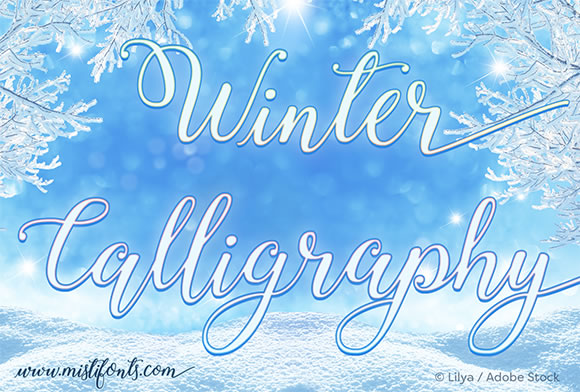
Winter Calligraphy is a handwritten script font that goes beyond a simple single-style offering. Its most notable feature is the inclusion of hundreds of alternate characters, including multiple versions of letters, ligatures, and swashes. This means you can avoid the repetitive look that sometimes plagues script fonts—each occurrence of a letter can be subtly different, mimicking the natural variation of real handwriting.
The font’s overall design is clean but not rigid. Strokes have a moderate thickness with slight contrast, giving it a fluid yet legible appearance. The style leans toward a modern calligraphic look—not too formal, not too playful. This balance makes it adaptable across many contexts, from branding to invitations to social media graphics. The sheer number of alternates is what really elevates it from a standard handwritten font to a more customizable tool.
How Winter Calligraphy Compares to Other Handwritten Font Options
If you’re evaluating handwritten script fonts, you’ll encounter several categories. On one end are minimal, single-style scripts that are easy to use but limited in expressiveness. On the other are elaborate display scripts with many alternates, often harder to implement. Winter Calligraphy sits in a middle ground that many designers find useful.
Versus Standard Script Fonts Without Alternates
Many popular handwriting fonts come with just one version of each character. They look fine at first glance, but when you type the same letter twice—especially in common words like “letter” or “people”—the repetition becomes noticeable. Winter Calligraphy addresses this by providing multiple alternates for most lowercase and uppercase letters, as well as ligatures that smooth out awkward letter combinations. This makes the final output feel more organic and less “typed.”
Versus High-End Display Scripts with Extensive Alternates
Some script fonts offer even more alternates and swashes, but they often require manual swapping via glyph palettes or OpenType features in software like Adobe Illustrator or InDesign. Winter Calligraphy supports OpenType features as well, but its alternate system is designed to be accessible. You can use automatic contextual alternates that swap in naturally as you type, reducing the need for manual intervention. This tradeoff matters: you get a good amount of variation without overwhelming the user. For someone who wants a polished look without spending hours tweaking glyphs, this is a strong advantage.
Versus Brush or Rough Handwritten Styles
Winter Calligraphy has a smooth, clean finish. It lacks the gritty texture or brushstroke irregularities found in some rough handwriting fonts. That is not a weakness—it simply means it suits different applications. If you need a font that reads clearly at small sizes or on busy backgrounds, Winter Calligraphy’s consistent stroke weight and clean edges help. For projects where a rougher, more tactile feel matters (say, a grunge poster), a brush script would be more appropriate. Knowing the difference helps you choose based on the emotional tone you want.
Strengths and Best-Fit Situations for Winter Calligraphy
Based on its design and feature set, Winter Calligraphy works especially well in several scenarios:
- Branding and Logos: The availability of alternates lets you create a unique wordmark that doesn’t look like anyone else’s. By manually selecting specific swashes or alternate letters, you can tailor the font to your brand’s personality.
- Wedding and Event Invitations: Handwritten scripts are a go-to for formal invitations, but many lack the variation needed to avoid a mechanical look. Winter Calligraphy’s alternates give each invitation a custom feel, while its legibility ensures guest names and details remain readable.
- Social Media Graphics and Quotes: For quote cards, Instagram posts, or banners, the font adds a personal touch. Its moderate stroke contrast works on light and dark backgrounds alike, especially when paired with a simple sans-serif for supporting text.
- Holiday and Seasonal Projects: Given its name, Winter Calligraphy naturally fits winter-themed designs, holiday cards, or year-end promotions. The style evokes a cozy, handcrafted aesthetic without being overtly themed.
Tradeoffs and Limitations to Consider
No font is perfect for every situation. Here are factors to weigh when deciding if Winter Calligraphy is the right choice.
Learning Curve for Alternates
While the font supports automatic substitution, getting the most out of the alternates still requires some familiarity with your design software’s OpenType panel. If you are a beginner or need to produce text quickly without glyph access, the default alternates may still look good, but you may not fully leverage the font’s capabilities. For professional designers who regularly work with script fonts, this is a minor consideration. For casual users, it might feel like an extra step.
Readability at Very Small Sizes
Like many script fonts, Winter Calligraphy is best used at medium to large sizes—ideally 14 points and above for body text, and larger for display purposes. At very small sizes (10pt or less), the delicate loops and swashes can become cramped, reducing legibility. If your project requires small text, such as captions or footnotes, consider pairing Winter Calligraphy with a clean sans-serif companion for those parts.
File Size and Performance
Because Winter Calligraphy includes hundreds of glyphs and alternates, the font file is larger than simple scripts. This is rarely an issue for desktop use, but for web embedding, you should check the file size and consider subsetting to include only the characters you need. Most modern web font services handle this, but it is worth noting if you plan to use it on a performance-sensitive website.
When You Might Need a Different Option
Winter Calligraphy is versatile, but it is not a one-size-fits-all solution. Consider other options if:
- You need extreme formality: The font has a friendly, approachable feel. For ultra-formal documents like legal certificates or corporate announcements, a more traditional calligraphic or serif typeface might be better suited.
- Your project demands maximum speed and simplicity: If you are a non-designer creating a quick flyer in a tool like Canva without OpenType support, you might prefer a simpler script that still looks good out of the box.
- You require high legibility in long reading passages: While Winter Calligraphy works for short headlines and quotes, it is not designed for lengthy paragraphs. For body copy, a typeface with clear letter spacing and simpler shapes will be kinder to readers’ eyes.
- You need a very rough or distressed aesthetic: As mentioned, Winter Calligraphy is smooth. For gritty or handmade looks, a brush or textured script would be more aligned.
Making an Informed Decision
When comparing handwritten fonts, focus on three factors: how much control you want over variations, the tone you need to convey, and the technical demands of your project. Winter Calligraphy offers a strong balance—it gives you ample flexibility through alternates, maintains solid readability at appropriate sizes, and carries a warm, modern calligraphic style. It is not the simplest option, nor the most ornate, but it sits in a sweet spot that serves many common design needs.
If you often work on branding, invitations, or social media content and you value a font that can be customized to avoid a generic look, Winter Calligraphy is worth considering. Test it with a few sample phrases using its automatic alternates to see if the natural flow meets your expectations. For more formal or minimal projects, keep other typefaces in your toolkit. By understanding what Winter Calligraphy does well and where it has tradeoffs, you can decide if it fits your specific use case—without feeling pressured by hype or limited by lack of options.