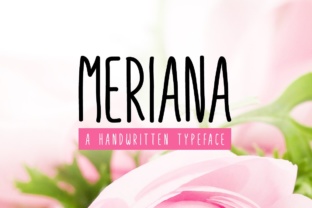
Meriana: A Handwritten Font That Balances Playfulness with Practical Legibility
Handwritten fonts often occupy a tricky space in typography. Many are charming at first glance but fail under real-world conditions—too ornate to read at small sizes, too irregular to use across multiple formats, or too stylized to pair well with other typefaces. Meriana enters this landscape as a self-described sweet, handwritten font built with legibility in mind. The claim is worth examining closely because it speaks directly to a common pain point: finding a typeface that feels personal and approachable without sacrificing clarity or professional utility.
Meriana is not a revival of vintage script nor a hyper-expressive brush lettering face. It occupies a middle ground—a deliberately crafted, somewhat whimsical handwritten style that retains enough structure to be functional in marketing, branding, and decorative design work. This review explores what Meriana actually offers, how it performs in practical settings, and who stands to gain the most from adding it to their font library.
What Makes Meriana Worth Attention
The handwritten font category is crowded. A quick browse through any marketplace reveals dozens of options claiming to be cute, friendly, or playful. Meriana distinguishes itself by foregrounding legibility as a core design objective rather than an afterthought. Many handwritten fonts are drawn with an artist’s hand first and a reader’s eye second, leading to ambiguous letterforms, inconsistent x-heights, and spacing that looks organic but reads poorly. Meriana appears to have been conceived with both concerns in mind.
The letter forms are rounded, open, and generally uncomplicated. Ascenders and descenders are proportional without being exaggerated, which helps maintain readability across body text sizes and display applications. The sweetness of the font comes through in the slight irregularity of stroke weights, the gentle curves, and the overall softness of the shapes, but these traits are kept in check by consistent baseline alignment and predictable letter widths. This restraint is what separates a usable handwritten font from one that only works in isolated display contexts.
Another notable aspect is the absence of excessive flourishes or decorative swashes. Many handwritten fonts overcompensate with ornamental details that look appealing in a specimen but become distracting in actual use. Meriana keeps its gestures subtle, which makes it more versatile for projects where the text itself needs to carry meaning, not just aesthetic weight. This design philosophy suggests the creator understood that a font used for branding or marketing must communicate information first and personality second.
Key Characteristics and Design Choices
Meriana is a complete character set font with uppercase and lowercase letters, numerals, punctuation, and basic multilingual support. The lowercase alphabet is where most of the personality lives. The letters are drawn with a natural, slightly irregular hand—no two strokes feel mechanically identical, but they also don’t feel chaotic. The a, e, and g are particularly well executed, retaining the single-story forms common in handwriting but with enough openness to avoid confusion. The r and s are also worth highlighting, as these letters often cause legibility issues in handwritten typefaces when condensed or overly stylized.
The uppercase set is simpler, which works to Meriana’s advantage. Capital letters are less adorned than the lowercase, making them suitable for headings and short emphasis without overpowering surrounding text. This asymmetry between uppercase and lowercase is a deliberate design choice that gives the font a natural rhythm—heads are clean, bodies are soft. For designers and marketers, this means less time spent adjusting tracking or kerning pairs to achieve visual harmony.
Spacing is generous but not wasteful. The default letter spacing allows the font to breathe, which is critical for applications like social media graphics, presentation titles, or product packaging where text must remain readable at a glance. The generous spacing also helps the font perform better on screens, where handwritten faces often blur or lose detail at smaller sizes. Meriana’s glyphs are wide enough to maintain their shape even in less-than-ideal rendering conditions.
Weight distribution is another considered element. The thick-thin contrast is present but moderate, giving the font a sense of movement without creating legibility problems. Strokes feel natural without being sloppy. The overall impression is that of a carefully written note—personal, warm, but intentional.
Real-World Performance and Usability
Testing Meriana across several common use cases reveals where it excels and where it may fall short. In display settings—such as headlines, poster text, logos, and social media banners—the font performs very well. Its sweetness reads as approachable and friendly, which suits brands targeting younger demographics, lifestyle products, children’s content, or creative services. At sizes above 24 points, the character shapes are clear, and the personality is immediately apparent without being overwhelming.
Meriana works adequately for short body text, such as product descriptions, pull quotes, or short paragraphs in editorial layouts. However, it is not a replacement for a text-oriented face in long-form reading. Like most handwritten fonts, extended passages set in Meriana will cause fatigue. The irregular stroke patterns, while charming, lack the rhythmic consistency that serif or sans-serif text faces provide for sustained reading. Using it for more than two or three consecutive sentences at small sizes reduces legibility, especially on screens with lower resolution.
On the practical side, the font includes standard ligatures and supports basic OpenType features. It works across major design software including Adobe Creative Suite, Figma, Canva, and web-based tools. File sizes are reasonable, and installation is straightforward. For web use, the font loads cleanly and renders predictably across modern browsers, though testing on older browsers or low-end mobile devices may reveal minor rendering inconsistencies at very small sizes—a common limitation for handwritten fonts that lack hinting optimization.
Pairing Meriana with other typefaces is relatively easy due to its neutral baseline and moderate contrast. It pairs naturally with clean sans-serifs like Inter, Lato, or Nunito for a contemporary look, and with classic serifs like Playfair Display or Lora for a more editorial feel. The key is to let Meriana carry the personality while the partner font handles structure and readability in longer text. This makes it a flexible secondary typeface in a brand system.
Who Benefits Most from Meriana
Based on its characteristics and performance, Meriana serves a specific but broad audience. Entrepreneurs and small business owners building a brand from scratch will find it useful for logo concepts, packaging labels, website headers, and social media content. The font conveys approachability and warmth, which helps humanize a brand without requiring expensive custom lettering. For a boutique bakery, a children’s clothing line, a stationery shop, or a creative coaching service, Meriana offers an authentic handwritten aesthetic that feels personal rather than corporate.
Marketers and content creators working across digital channels will appreciate Meriana’s readability in thumb-stopping formats. Instagram stories, Pinterest pins, YouTube thumbnails, and email headers all benefit from a font that reads quickly and creates an emotional tone. The font’s sweetness works particularly well for seasonal campaigns, product launches, and announcements targeting consumers looking for something genuine or relatable.
Freelance designers and illustrators can leverage Meriana as part of a broader toolkit when a handwritten look is needed but time or budget prevents commissioning custom lettering. Its consistency across uppercase and lowercase reduces the need for manual adjustments in layout. For educators and bloggers creating printable resources, worksheets, or course materials, the font’s legibility at moderate sizes makes it suitable for headings, bullet points, and callouts where a personal touch complements the content.
That said, Meriana is not ideal for highly formal or corporate contexts. Its sweet personality does not translate well into legal documents, financial reports, academic papers, or any setting where neutrality and authority are paramount. It also may not suit brands that require a rugged, edgy, or industrial aesthetic—the font is fundamentally gentle in demeanor. Designers working in those spaces should look elsewhere.
Practical Recommendations for Getting the Most Out of Meriana
For those considering Meriana for a project, a few practical guidelines can maximize its effectiveness. First, use it at sizes where its details are visible. Below 14 points on screen or 10 points in print, the font’s charm begins to fade as stroke irregularities become less distinguishable and letters risk blending. Display sizes between 24 and 48 points are the sweet spot for most applications.
Second, limit its use to short text passages. Reserve Meriana for headlines, subheadings, quotes, and accent text. Pair it with a clean sans-serif for body copy to maintain overall readability. This approach preserves the font’s personality while ensuring the user experience does not suffer from fatigue.
Third, consider color treatment. Meriana performs well in both solid and muted color palettes, but it particularly shines in warm tones—soft pinks, peachy oranges, warm grays, and cream backgrounds amplify its friendly character. High-contrast combinations, like dark charcoal on white, work for legibility but may reduce some of the warmth. Experiment with tints and gradients for digital applications.
Fourth, avoid overusing it across too many visual elements simultaneously. Meriana works best as a single accent voice. Using it for headings, captions, labels, and body text in the same layout creates visual monotony and reduces the impact of its stylistic contribution. Let it speak once per composition.
Fifth, test the font in your actual medium before committing. Print at various sizes, preview on mobile devices, and view on different screen types. While Meriana is well-optimized compared to many handwritten fonts, no typeface behaves identically across all environments. Spending time in testing prevents surprises during production.
Considerations and Potential Limitations
No font is perfect for every situation, and Meriana has clear boundaries worth acknowledging. Its character set, while sufficient for most English-language projects, does not include extensive Latin diacritics or support for non-Latin scripts. Users working with Central European, Cyrillic, or Asian languages may find gaps in coverage. Always verify language support before purchase or download.
The font’s sweetness may limit its lifespan in a brand system. Trends in typography shift, and what feels fresh and personal today may read as dated in a few years. This is a consideration for brands that intend to maintain visual consistency over the long term. Meriana is well-suited for campaigns, seasonal materials, or short-term branding, but businesses planning a decade-long visual identity may want a more neutral primary typeface.
Additionally, the font’s legibility at small sizes, while better than many handwritten alternatives, still falls short of optimized text faces. For footnotes, captions, or any text below 10 points, Meriana becomes difficult to read. This is not a flaw in the design but a reminder that handwritten fonts have practical limits appropriate to their genre.
Finally, pricing and licensing should be checked carefully. Meriana is available through various type foundries and marketplaces with different licensing models. Ensure the license covers your intended use—commercial projects, web embedding, or app integration. Misunderstanding licensing terms is one of the most common mistakes designers make with specialty fonts, and it can lead to costly corrections down the line.
Is Meriana Right for Your Project?
Meriana occupies a valuable niche in the handwritten font market. It delivers on its promise of being sweet and legible, offering enough structure for professional use while retaining the warmth that makes handwritten typefaces appealing. It is not a revolutionary design, but it is a reliable and well-executed tool that serves its intended purpose effectively. For entrepreneurs, marketers, designers, and content creators who need an approachable, human voice in their visual communication, Meriana is a practical choice worth serious consideration. Evaluate it within the context of your specific project needs, test it in your workflow, and use it where its strengths align with your goals.