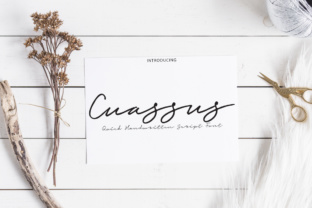
The Quiet Charm of Cuassus: How a Single Font Can Reshape Your Design Voice
In an era where design tools offer limitless typefaces, many creators find themselves circling back to the same handful of safe choices. Helvetica, Roboto, Playfair Display—they are reliable, well-tested, and utterly predictable. But predictability rarely sparks emotion. When you need to communicate warmth, individuality, or a handcrafted sensibility, the font you choose becomes the visual equivalent of tone of voice. This is where Cuassus enters the conversation, not as a revolutionary departure, but as a quiet reinvention of what a personal touch can look like.
Why Personality Matters More Than Polish
Design standards have shifted dramatically over the past decade. Consumers and clients alike have grown weary of sterile, corporate aesthetics. The rise of hand-lettered signage, imperfect textures, and bespoke typography signals a broader cultural appetite for authenticity. A font that feels slightly off-kilter—intentionally uneven or whimsical—can communicate sincerity far more effectively than a perfectly kerned sans-serif. Cuassus taps directly into this desire. It is not trying to be invisible; it is trying to be memorable. That distinction is crucial for anyone creating invitations, greeting cards, holiday correspondence, or any project where the recipient should feel a human connection rather than a production-line efficiency.
Consider the typical birthday invitation. A standard script or formal serif might convey elegance, but it rarely conveys you. Cuassus, by contrast, brings an almost handwritten energy to the page. Its letterforms carry a casual poise that suggests the words were penned with care rather than extruded by algorithm. That impression matters. In a world saturated with digital clutter, the smallest signal of effort can elevate a piece from forgettable to treasured.
Anatomy of a Personality-Driven Typeface
To understand why Cuassus works so well in personal projects, it helps to examine what its designers actually built into the glyphs. The font does not rely on extreme swashes or decorative flourishes. Instead, it finds character in subtler details: slight variations in stroke weight, gently irregular baseline rhythms, and terminals that feel natural rather than mechanically precise. These features mimic the inconsistencies of real handwriting without sacrificing readability. That balance is harder to achieve than it sounds. Many decorative fonts sacrifice legibility for flair, leaving readers squinting at loops and descenders. Cuassus avoids that trap by keeping its x-height generous and its letter spacing open enough to breathe.
For educators and researchers studying typography and cognition, Cuassus offers an interesting case study in how non-standard typefaces affect emotional response. Readers do not process such a font as quickly as they would a utilitarian face, but they do process it more warmly. The slight extra moment spent deciphering a unique shape can translate into a feeling of engagement rather than frustration, provided the design is executed thoughtfully. Cuassus is executed thoughtfully. Its quirks feel intentional, not sloppy.
What Actually Makes a Font Feel Personal?
Typography experts often point to three variables that determine whether a typeface feels human or mechanical: rhythm, contrast, and terminal shape. A mechanical font like Arial maintains identical stroke widths and perfectly horizontal baselines. A humanist font introduces subtle variation. Cuassus amplifies this humanist approach by leaning into irregular stroke contrast—thin upstrokes, slightly thicker downstrokes—without becoming calligraphic. The result is a font that sits comfortably between a casual script and a clean sans-serif, occupying a niche that few other typefaces fill well. For hobbyists creating scrapbooks or custom stationery, this middle ground is invaluable. It allows for personality without requiring extensive design experience to pair it with other elements.
Real-World Applications Across Creative Contexts
While Cuassus shines in obvious use cases like birthday and Christmas cards, its versatility extends further than many initially assume. Business owners, for example, often struggle to brand themselves without resorting to cliché. A boutique bakery, a children's bookstore, or a wedding photography studio can all benefit from a typeface that signals approachability. Using Cuassus on signage, menu headers, or social media graphics immediately communicates that the business values individual attention over mass-market appeal. It does not replace a proper logo, but it can unify collateral materials with a consistent, personable voice.
Educators frequently design classroom materials—worksheets, certificates, parent newsletters—that need to feel encouraging rather than bureaucratic. A font like Cuassus can soften the tone of an otherwise dry document. Imagine a reading log for young students set in a font that feels playful yet clear. The child associates the activity not with tedious administration but with the warmth of the type itself. Similarly, researchers preparing conference posters on community-focused topics might use Cuassus for pull quotes or section headings to invite viewers into the content rather than intimidating them with dense academic serifs.
Holiday Cards and Seasonal Projects
The holiday season presents a unique typographic challenge. Christmas cards, Hanukkah greetings, and New Year's notes must balance festivity with sincerity. Overly elaborate scripts can feel ostentatious; standard sans-serifs feel impersonal. Cuassus navigates this tightrope effectively. Its gentle irregularities evoke the warmth of a hand-addressed envelope without requiring hours of lettering practice. When paired with a seasonal color palette—deep green, burgundy, navy—the font anchors the design in something that feels both modern and nostalgic. For creators producing multiple cards at scale, Cuassus also maintains readability even when printed at smaller sizes, which is a frequent pain point with more decorative options.
Birthday invitations follow a similar logic. Whether the celebration is for a five-year-old or a fifty-year-old, the invitation sets the emotional tone. Cuassus works especially well for milestone birthdays where you want to blend formality with a personal note. Consider a "60th Birthday Celebration" header: the font's character prevents the event from feeling stiff, while its legibility ensures guests immediately grasp the details. For DIY creators using print-at-home templates, Cuassus also behaves predictably across different papers and printers, reducing the risk of smudged or illegible fine print.
Practical Considerations for Designers and Hobbyists
No typeface is universally perfect, and Cuassus has its own considerations. Its personality is pronounced enough that it may conflict with highly formal branding guidelines. A law firm or financial institution would likely find it mismatched with their established identity. That is not a flaw; it is a signal of the font's specificity. The key is knowing when to deploy it. For creators who work across multiple projects, maintaining a mental library of each typeface's emotional register is essential. Cuassus belongs in the "warm, casual, personal" category, alongside fonts like Freight Text or FF Tundra, but with a lighter, more playful footprint.
From a technical standpoint, Cuassus performs well in both print and digital environments. Its relatively even color on the page means it does not create distracting dark spots when used in body-sized applications, provided the point size is adequate. For body text, a size of 12 to 14 points with generous leading keeps the font's personality from overwhelming readability. For display purposes, such as headings or short quotes, sizes above 24 points allow the subtle stroke variations to become visible assets. Designers should also pay attention to tracking: a small amount of positive letter-spacing can enhance the handcrafted feel without making the text appear disconnected.
Pairing Cuassus with Other Typefaces
One area where Cuassus truly excels is in pairings. Because it carries a distinct but not dominating voice, it plays well with neutral sans-serifs like Montserrat or Open Sans. The contrast between a straightforward header in Cuassus and a clean body text in a simple sans-serif creates a clear visual hierarchy. Alternatively, pairing it with a refined serif like Lora or Cormorant Garamond can produce an unexpectedly elegant tension—the organic warmth of Cuassus against the classical structure of the serif. For hobbyists less comfortable with typographic theory, a safe starting point is to use Cuassus for the main message and a lightweight sans-serif for supporting details. This approach almost always yields a balanced, approachable layout.
Workflows for Integrating Cuassus into Real Projects
Adopting a new typeface effectively requires more than just downloading it. A practical workflow might begin with sketching the core message on paper, then moving to digital layout software where Cuassus is applied at varying sizes to test its behavior. For an invitation project, set the event name in 36-point Cuassus, the date in 16-point, and the body details in 12-point. Adjust line spacing to prevent collision between descenders and ascenders. If the text includes numerals—common in dates and addresses—check that they align visually with the surrounding letterforms. Cuassus handles numerals competently, but like any personality-driven font, a quick visual check prevents surprises.
For business owners using the font across branded materials, consistency is key. Define a style guide: use Cuassus for headlines and call-to-action phrases, but rely on a neutral companion for long paragraphs. This preserves the font's impact while ensuring readability over longer texts. Social media graphics can use Cuassus for quote overlays or product announcements, leveraging its handcrafted feel to cut through algorithmic noise. A/B testing—even informal testing among friends or colleagues—can reveal whether the typeface positively influences message reception. Informal feedback often indicates that recipients perceive Cuassus-set text as more effortful and sincere, which directly benefits brand perception.
Comparative Observations: Cuassus in a Crowded Field
The typeface landscape includes hundreds of fonts vying for the label "friendly" or "personal." What sets Cuassus apart from competitors like Amatic SC, Caveat, or the ubiquitous Brush Script? The answer lies in restraint. Many casual scripts loudness, with exaggerated loops and slants that demand attention. Cuassus keeps its voice conversational rather than declamatory. It does not insist on being the centerpiece; it supports the message. This quality makes it more versatile across different project types and less likely to clash with other design elements. A font that can accompany a watercolor illustration, a minimalist line drawing, or a photographic background without fighting for dominance is a font worth keeping in your toolkit.
From a user experience standpoint, Cuassus also scores well on accessibility. Its relatively open counters and distinct letter shapes reduce confusion between similar characters, such as lowercase 'l' and uppercase 'I'. For older audiences or individuals with visual processing differences, this clarity is a genuine advantage. The font does not sacrifice inclusivity for style—a consideration that responsible designers increasingly prioritize.
Future Trends and the Role of Personal Typefaces
As artificial intelligence and automated design tools become more prevalent, the value of assets that feel distinctly human will only increase. Typefaces like Cuassus represent a counterbalance to algorithmic homogenization. They remind viewers that a real person crafted the message. This is not a luddite position; it is a strategic recognition that emotional differentiation is becoming the primary competitive advantage in saturated markets. Whether you are a professional designer preparing a boutique campaign, a teacher creating classroom materials, or a parent sending holiday greetings, the typeface you choose communicates volumes before anyone reads a single word.
Cuassus occupies a sweet spot that few other fonts manage: it is personal without being precious, expressive without being exhausting. Its quirks feel earned, its warmth genuine. For anyone looking to step away from default choices and inject a bit of themselves into their work, it offers a reliable, beautiful, and surprisingly versatile path forward. The next time you sit down to design an invitation, a card, a poster, or a simple note, consider what your typeface says about the hand that sent it. With Cuassus, that hand feels human.