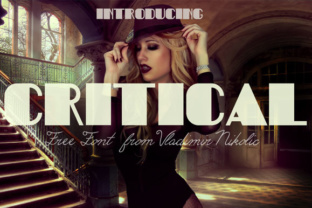
Critical: A Practical Display Font for Modern Workflows
Typography is rarely an afterthought in serious work. Whether you are designing a landing page, laying out a presentation, or building a brand identity, the typeface you choose carries weight. It sets tone, guides attention, and reinforces the message. Among the many free options available today, Critical, a display font created by Vladimir Nikolic, stands out as a tool that rewards deliberate use. It is not a generic all-purpose face, but a carefully designed instrument that fits specific moments in a creative or professional process. Understanding where and how to place it within a broader workflow is what turns a good font into an effective asset.
Critical is a display font, meaning it is built for impact at larger sizes rather than for extended body text. Its geometric structure, sharp terminals, and distinctive character shapes give it a modern, authoritative presence. Vladimir Nikolic designed it with clarity and boldness in mind, making it particularly suitable for headlines, titles, signage, and other contexts where a strong visual statement is needed. Because it is free, it removes the barrier of licensing costs, allowing freelancers, small teams, and entrepreneurs to access professional-grade typography without stretching a budget.
Yet a typeface is only as useful as the workflow that supports it. Knowing how to integrate Critical before a project begins, during the design process, and after a launch helps ensure consistency and reduces rework. The following sections break down practical ways to make Critical a reliable part of your toolkit.
Where Critical Fits in a Broader Process
Every project follows a cycle: planning, execution, review, and delivery. Typography decisions should align with each phase rather than being tacked on at the end. Critical is best introduced during the planning stage, when you define the visual hierarchy and emotional tone of the piece. Because it is a display font, it typically serves as the primary heading face or a hero element. Once you decide that Critical will handle titles, you can build the rest of the type system around it — choosing a complementary body font, establishing spacing rules, and setting size scales.
During the execution phase, Critical becomes a practical tool for layout. Its consistent stroke weight and open counters make it readable even at moderate sizes, which is useful for subheadings, pull quotes, or call-to-action buttons. When used in digital interfaces, its geometric forms align well with modern UI patterns, especially in minimalist or tech-oriented products. For print, Critical’s sharp edges hold up well in posters, flyers, and business cards where ink spread might soften other fonts.
After a project ships, Critical continues to offer value. Since it is a free font, it can be shared across teams without licensing complications. If you maintain a style guide, documenting Critical’s usage rules — such as minimum size, letter-spacing adjustments, and color combinations — ensures that future iterations or collateral remain visually coherent. This kind of post-project documentation saves time and prevents drift when multiple people contribute to the same brand.
Integrating Critical with Other Tools and Methods
No font operates in isolation. Critical interacts with design software, code environments, and even decision-making frameworks. Understanding these interactions helps you avoid common friction points.
Design Software Compatibility
Critical comes in standard font formats (such as OTF or TTF), which means it works with virtually all major design tools: Adobe Illustrator, Photoshop, Figma, Sketch, Affinity Designer, and Canva. In vector-heavy workflows, Critical’s clean geometry responds well to scaling and transforms without losing definition. For motion design, characters with consistent proportions are easier to animate, whether you are building a kinetic typography piece or a simple logo reveal.
If you work in a code-based environment — for example, building a static site with CSS or prototyping in Webflow — Critical may not be available as a web font by default. You will need to host the font files yourself or use a service like Google Fonts (if it is added there). Alternatively, you can convert the font to WOFF2 for web use. Planning for this during the development phase avoids last-minute font swaps that can shift layout and break typographic rhythm.
Pairing with Body Fonts
A display font like Critical rarely carries the entire reading experience alone. Pairing it with a neutral, highly readable body font improves legibility for long text and creates contrast. Good companions include system fonts like Inter, Roboto, or Open Sans for digital work, or serif options like Merriweather for print. The key is to maintain enough visual difference while ensuring that the body font does not compete with Critical’s bold personality. Test pairings early in the project — ideally before committing to a full design — because changing a typeface mid-process often cascades into spacing, sizing, and color adjustments.
Color and Contrast Considerations
Critical’s strong forms perform best against high-contrast backgrounds. A dark background with a light text color or vice versa makes the geometric details stand out. Avoid placing Critical on busy or low-contrast backgrounds, as the sharp terminals can become lost or visually cluttered. If you are designing for accessibility, ensure that any text set in Critical meets WCAG contrast ratios. Because display fonts are often used at larger sizes, foreground-to-background contrast remains critical for readability, especially on screens with varying brightness.
Practical Implementation Tips
Integrating a new font into an established workflow requires more than downloading a file. The following practices help you use Critical efficiently from the first project onward.
- Organize your font library. Store Critical in a dedicated project folder or a shared team repository. Label the file clearly, including the font version and any variant (Regular, Bold, etc.). This prevents confusion when multiple team members access the asset.
- Set baseline sizing rules. Decide a minimum size for display usage. For print, avoid using Critical below 14 points in body-like applications; for web, keep it above 1.5 rem for headings. This respects its display nature and maintains legibility.
- Adjust letter-spacing for context. At very large sizes (like full-screen hero titles), slightly increased letter-spacing (tracking) can improve readability and give a more polished look. At medium sizes (subheadings), default spacing often works best. Test both extremes.
- Create a typographic scale. Define size increments for H1, H2, H3, and any special uses. Critical may only cover two or three levels in your hierarchy, so assign it where it provides the most visual return: primary headline and maybe a secondary callout.
- Save reusable styles. In Figma, Sketch, or a CSS preprocessor, save Critical’s settings (size, weight, spacing, color) as a named style. This lets you apply consistent typography across multiple pages or screens without manually adjusting each instance.
Workflow Examples Across Disciplines
Critical adapts to different fields, but the integration method changes slightly depending on the output. Below are three common scenarios.
For a Designer Launching a Brand Identity
When building a visual identity for a tech startup or a creative agency, Critical can anchor the logo or serve as the headline font in key brand materials. During the research phase, test Critical against the brand’s core values: if the brand communicates modernity, precision, and confidence, Critical aligns naturally. Sketch several wordmark concepts using Critical, then move into color exploration. Once approved, define usage rules for all future collateral — business cards, slide decks, social media templates — and include Critical in the brand’s font asset library. This upfront investment prevents inconsistencies when multiple freelancers or team members produce materials later.
For a Marketer Building a Landing Page
A landing page needs hierarchy. Critical works well for the main headline — often the first element a visitor sees — and for section headers that guide scrolling. In the wireframing stage, mark where Critical will appear. During design, set the headline size to at least 3–4 rem on desktop and scale down proportionally for mobile. Because Critical is a display font, avoid using it for button labels or fine print; instead, pair it with a clean sans-serif for body and UI elements. Before publishing, preview the page on different screen sizes to ensure Critical’s letterforms do not become cramped at smaller viewports.
For a Freelancer Creating a Portfolio or Pitch Deck
Personal branding often relies on a strong first impression. Using Critical for your name, the title slide, or section headings in a PDF portfolio or a slide deck immediately signals attention to detail. After setting up the master slide or template, apply Critical consistently across all heading levels. Export the file as a PDF, but also test the native file format if your client will edit it later — make sure Critical is embedded or linked properly to avoid substitution errors. For a presentation delivered live, Critical’s readability at size helps the audience focus on key takeaways even from the back of the room.
Preparation, Quality Control, and Long-Term Use
Once Critical becomes part of your regular workflow, maintaining consistency requires a few ongoing habits.
Preparation. Before starting any new project that uses Critical, update the font file to the latest version if available. Check for any known rendering issues on the platforms you target (some older browsers may not support newer OpenType features). Also, verify that the font license permits commercial use — Critical is free, but it is always wise to confirm the specific terms provided by the designer.
Quality control. Preview Critical at the intended output size early in the design process. A font that looks balanced on a 27-inch monitor may appear heavy or tight on a mobile screen. Test across devices and in both light and dark modes. For print, run a test print at actual size to check for any misbehaving letters or spacing anomalies. If you notice issues, adjust letter-spacing or size rather than forcing the font into a role it was not designed for.
Long-term use. Over time, you may build a library of projects that use Critical. Keep a simple spreadsheet or note in your style guide listing which projects use it, the version number, and any custom settings you applied. This makes it straightforward to update a font across multiple files if a new version is released. Also, periodically review whether Critical still fits the brand or project as it evolves. A typeface that suits a startup’s early identity may feel mismatched after a rebrand, but for many small businesses and freelancers, Critical’s clean aesthetic holds its value well over years of use.
Observations for Smooth Integration
Critical is not a font that hides in the background, and that is its strength. But its assertive voice means it should be used with intention. Avoid applying it to every heading just because it is available. Reserve it for moments that matter: the primary message, the key identifier, the visual anchor. This restraint actually makes the font more effective when it does appear.
Because Critical is a display font, it pairs best with restraint in other design elements. Avoid crowding it with decorative borders, competing textures, or multiple typefaces. Let the font do the heavy lifting. In layouts that use a lot of imagery, Critical can sit comfortably either over a clean image area or in a dedicated text band. If you are designing for a multilingual audience, test Critical with accents and special characters — Vladimir Nikolic included a range of glyphs, but it is wise to verify coverage for your specific language needs.
Finally, share what you learn. If you discover a particularly effective pairing or a size configuration that works well in a specific context, document it. Whether you work alone or in a team, these small notes become valuable reference points. Critical is a tool that rewards thoughtful use, and the more you embed it into your regular process, the more it becomes a natural extension of your work rather than an occasional novelty.
By approaching Critical as a deliberate choice within a larger system — planning its role, testing its interactions, and maintaining consistency across projects — you turn a free display font into a reliable asset that supports real outcomes. That is the difference between simply using a font and truly integrating it.