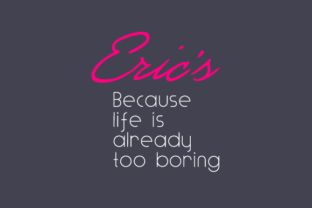
Eric s: A Free Handwritten Font Worth Understanding Before You Use It
If you have spent any time searching for handwritten fonts, you have likely come across Eric s. Created by Vladimir Nikolic, this free typeface has a natural, unpolished charm that appeals to designers, bloggers, small business owners, and hobbyists alike. Its casual strokes and slightly irregular letterforms give it a human feel that many polished scripts lack. But like any free resource, popularity does not guarantee it is right for every project. Understanding what Eric s actually offers, where it works best, and what traps to avoid can save you time, frustration, and a less-than-professional final result.
Before you download another handwritten font, pause. Many people grab a free script, drop it into a project, and wonder why the outcome feels off. The problem is rarely the font itself. It is usually how it is chosen, where it is used, or how it is handled. Let us walk through the common missteps so you can make Eric s work for you rather than against you.
Mistaking Handwritten for Careless
One of the most frequent misunderstandings about fonts like Eric s is assuming that handwritten means unstructured or easy to use anywhere. The raw, sketch-like quality that makes Eric s appealing can also make it a poor fit for formal or information-heavy layouts. Its uneven stroke widths and relaxed spacing are part of its character, but they reduce readability in body text, small sizes, or lengthy paragraphs.
People often treat all script fonts as interchangeable. Eric s is not a replacement for a clean cursive script or a calligraphic face. It belongs in projects where a personal, hand-drawn touch adds warmth — invitations, posters, branding for handmade products, or short headlines. Using it for dense blocks of text or professional correspondence usually backfires. The reader has to work harder to parse each word, which reduces engagement and trust.
The better approach is to match the font to the job. Reserve Eric s for places where you want to communicate approachability and a DIY aesthetic. Pair it with a clean sans-serif for body copy so the contrast does the heavy lifting. Your design will feel intentional rather than accidental.
Overlooking Licensing Details in Free Fonts
Free does not mean unrestricted. Many people download Eric s from various sites without checking the license. Vladimir Nikolic released it as a free font, but free fonts often carry conditions about commercial use, embedding, or modification. Some allow personal use only. Others require attribution. A few restrict use in specific media like apps or merchandise.
The mistake is assuming that because it is free, you can use it however you want. This assumption leads to legal headaches, especially for entrepreneurs, marketers, and small business owners who use the font in logos, product packaging, or advertising. A client or platform may require you to prove you have the right to use the typeface commercially. If you cannot, you may have to redesign materials or pay for a license after the fact.
Always download Eric s from the original source or a reputable font library that clearly lists the license. Read the terms before you add it to your toolkit. If you need a handwritten font for commercial projects and the license is unclear, look for one with an explicit commercial-use statement. It takes five minutes and saves you much more time later.
Ignoring Font Pairing and Hierarchy
A common sight in beginner design work is a single handwritten font used for everything — headings, subheadings, body text, captions. The result is visually monotonous and hard to scan. Even a beautiful face like Eric s loses its appeal when there is no contrast to guide the eye.
Handwritten fonts are accent pieces. They work best when they take one role, usually display or heading text, while a simpler typeface handles the rest. Without this hierarchy, your message gets buried. Readers do not know where to look first, and the overall design feels cluttered or amateur.
Try this: use Eric s for a main headline or a pull quote. Then pair it with a neutral sans-serif like Open Sans, Lato, or Montserrat for supporting text. Keep the script size generous — 24 points or larger — and the secondary font smaller but highly readable. The contrast between the organic strokes of Eric s and the clean lines of a non-script face creates a professional rhythm.
If you are designing a logo or a social media graphic, limit the handwritten element to the primary word or name. Let everything else stay simple. Your audience will notice the handcrafted feel without struggling to read it.
Downloading from Untrusted Sources
Free fonts are widely available, but not every download site is safe. Some bundle extra software, inject ads, or serve outdated versions. Others may claim to host Eric s but actually offer a modified or poorly converted copy that lacks proper hinting or glyph support.
Using a corrupted or incomplete font file affects how the typeface renders on screen and in print. You might see missing characters, broken kerning, or unexpected spacing. Worse, a poorly sourced file can introduce performance issues or security risks, especially if you are installing fonts on a work computer or sharing them with a team.
Stick to trusted platforms: Google Fonts, Font Squirrel, DaFont (with caution on license verification), or the designer's own site. For Eric s, check the original release by Vladimir Nikolic. If you cannot find the official page, use a known aggregator that verifies the files. Test the font in a simple document before committing to a large project. A few minutes of verification upfront prevent hours of troubleshooting later.
Neglecting to Test at Different Sizes and Mediums
What looks charming on your screen at 36 points may become illegible when printed at 12 points or displayed on a mobile device. Handwritten fonts often have thin strokes, tight loops, or irregular spacing that do not scale evenly. Eric s has a relatively strong stroke weight for a handwritten face, but it still benefits from size testing.
Designers, bloggers, and educators frequently skip this step. They choose a font based on how it looks in a preview, apply it across a project, and only notice problems when something is already printed or published. By then, fixing it means redoing layouts, reordering materials, or losing time.
Before you finalize any design that uses Eric s, test it at the sizes and mediums you actually need. Print a sample. View it on a phone screen. Check it in a PDF. Look at it on a projector or large monitor if you plan to use it for presentations. Adjust size, letter-spacing, or color until the text remains readable and retains its character.
If the font breaks down at smaller sizes, do not force it. Use it only where it shines and choose a more legible alternative for small or dense text. That is not admitting defeat — it is using the right tool for the job.
Forgetting About Readability and Accessibility
Handwritten fonts naturally have lower legibility than standard typefaces. That is not a flaw, but it becomes a problem when the audience includes people with visual impairments, reading difficulties, or those accessing your content on low-resolution screens.
This issue matters for educators, marketers, and anyone producing content for a broad audience. Using Eric s for large blocks of body text excludes readers who need clear letterforms to stay engaged. Even in headings, overly stylized characters can confuse people who rely on consistent shapes to recognize words quickly.
The fix is simple: use handwritten fonts sparingly and support them with ample spacing, high contrast, and a fallback option. On the web, include a reliable system font or a web-safe sans-serif in your font stack so that if Eric s does not load, the page remains readable. For print, keep the handwritten text large and surrounded by white space.
Ask yourself: can someone skim this and still understand the message? If the answer is no, adjust the layout or swap the font. Your content should serve the reader first; style comes second.
What to Check Before You Commit to Eric s
Before you download and install Eric s, take a few minutes to evaluate whether it fits your actual needs. Here is a quick checklist:
- License — Does it allow commercial use? Do you need to give credit? Can you modify it?
- Source — Are you downloading from the original designer or a reputable repository?
- Glyph set — Does it include the characters you need (accents, punctuation, ligatures)?
- Format — Is it available as OTF or TTF? Does it work on your operating system and software?
- Readability — Have you tested it at your intended sizes and on your target devices?
- Pairing — Do you have a complementary typeface ready for body text and secondary elements?
Answering these questions upfront turns a free font download into a reliable design asset. You avoid the frustration of redoing work, the embarrassment of a hard-to-read publication, and the risk of using a font without proper rights.
Using Eric s the Right Way
When used thoughtfully, Eric s brings a genuine handmade quality to your projects. Its free availability makes it accessible, but thoughtful application makes it effective. Use it in headlines for a craft fair poster. Drop it into a personal blog header or an invitation. Let it add texture to a product label or a social media graphic. Pair it with clean, neutral typefaces and give it room to breathe.
The difference between a design that looks intentional and one that looks thrown together often comes down to how you handle the details — size, contrast, hierarchy, and testing. Eric s can be a strong addition to your font library if you respect its strengths and work around its limits.
If you are looking for more free script fonts to expand your options, take a look at our free fonts page. You will find alternatives that offer different weights, styles, and levels of formality. Each one has its own personality, and each one deserves the same careful consideration. Choose with purpose, test thoroughly, and your audience will thank you.