The Versatile Charm of Myfrida Hollow: A Handwritten Font with Depth and Playfulness
Typography has the power to shape how a message is received, and few typefaces manage to balance fun and function as gracefully as Myfrida Hollow. This handwritten font, with its rounded contours and playful glyphs, offers designers a tool that feels both personal and polished. Unlike many script fonts that lean heavily toward formal cursive or overly whimsical doodle styles, Myfrida Hollow occupies a sweet spot where creativity meets readability. It invites the viewer in without screaming for attention, making it a strong candidate for projects that need warmth, approachability, and a touch of character.
What Makes Myfrida Hollow Distinctive
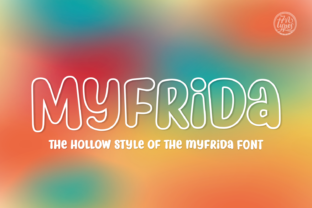
At first glance, Myfrida Hollow reveals its handwritten origins through irregular stroke widths and gently uneven letterforms. These imperfections are intentional and contribute to the font's organic feel. The rounded shapes soften the overall appearance, while the hollow or outlined style adds a modern twist. This version of the font is not a solid fill but an open contour, which gives it a lightweight, airy presence on the page. The playful glyphs include alternate characters and ligatures that encourage creative typesetting, allowing words to flow naturally rather than appearing mechanically spaced.
The font family also includes Myfrida Regular and Shadow Bold as separate offerings, but the Hollow variant stands out for its ability to layer over backgrounds, textures, or even other text. This opens up possibilities for two-tone effects, colored fills, or overlapping compositions that would be difficult to achieve with a standard solid typeface. The hollow design inherently draws the eye to the shape of each letter, making it ideal for headlines, logos, and short phrases where legibility and visual interest need to coexist.
Children's Books and Educational Materials
One of the most natural fits for Myfrida Hollow is in content designed for young audiences. The rounded, friendly letterforms resonate with the visual language of childhood, where soft edges and playful shapes dominate. Picture books, activity sheets, flashcards, and classroom posters all benefit from a typeface that feels inviting rather than instructional. The hollow style also works well for coloring activities, where children can fill in the letters with crayons or markers, turning reading practice into an interactive experience. Educators and publishers looking for a font that bridges the gap between learning and play will find Myfrida Hollow especially useful for title pages, chapter headings, and pull quotes.
Corporate Branding with a Human Touch
In the corporate world, typography often defaults to clean sans-serifs that convey efficiency but can feel cold. Myfrida Hollow offers an alternative for companies that want to soften their image without losing professionalism. Internal newsletters, team-building event posters, welcome packets, and casual brand communications can all incorporate this font to signal approachability. Startups in creative industries, co-working spaces, and lifestyle brands frequently use handwritten fonts to differentiate themselves, and the Hollow variant adds an extra layer of modernity. Because it is not overly ornate, it pairs well with more structured fonts for body text, creating a contrast that feels deliberate rather than chaotic.
Event Invitations and Personal Projects
Wedding invitations, birthday party flyers, and holiday cards often rely on script fonts to convey sentiment, but many scripts are difficult to read at small sizes or in long passages. Myfrida Hollow sidesteps this issue by maintaining clear letter shapes while still looking handcrafted. The hollow style gives invitations a contemporary feel, and the ability to layer it over patterned backgrounds or watercolor washes adds depth without extra design work. For personal projects like scrapbooking, journaling, or custom gift tags, the font brings a consistent aesthetic that elevates homemade items into polished keepsakes.
Comparing Myfrida Hollow to Other Type Treatments
When placed alongside solid handwritten fonts, Myfrida Hollow occupies a unique niche. Traditional script fonts like Pacifico or Brush Script rely on thick strokes and connecting tails to create flow, which can become heavy when used in large sizes. Myfrida Hollow, by contrast, uses open contours that keep the design light. This makes it more suitable for layering and reduces ink usage in print, which is a practical consideration for large runs. Compared to outline fonts like those in the Chalkboard or Marker families, Myfrida Hollow offers more character variation and a less rigid structure, giving it a hand-drawn authenticity that feels less like a digital afterthought.
The font also compares favorably to other hollow or stencil typefaces, which often sacrifice fluidity for geometric precision. Myfrida Hollow retains the irregularities of handwriting, so it never looks mechanical. This is especially important for branding where the goal is to communicate personality and warmth. For designers who have used fonts like Dymo or Journal in the past, Myfrida Hollow provides a more polished yet equally playful option that works across both digital and print media.
Pairing with Other Fonts
Because Myfrida Hollow is inherently decorative, it works best when paired with simpler fonts for body text. Clean sans-serifs like Open Sans, Lato, or Work Sans provide a neutral backdrop that lets the headlines shine. For a more eclectic look, pairing it with a serif font like Playfair Display or Merriweather creates tension between old and new styles that can be visually striking. The key is to limit the use of Myfrida Hollow to headings, short phrases, or accent text, as long passages set entirely in the font can become tiring to read. A good rule of thumb is to use it for no more than twenty percent of the total text on a page.
Color and Layering Techniques
The hollow nature of Myfrida Hollow invites experimentation with color. Filling the letters with a gradient, a photograph, or a subtle pattern can produce stunning results in digital designs. In print, using a colored background with white lettering reverses the effect and emphasizes the hollow interior. Designers can also stack a solid version of the text behind the hollow version, offset by a few pixels, to create a shadow effect that adds dimension. This technique works particularly well for logos or event titles where a three-dimensional look is desired without resorting to complex vector work.
Size and Spacing Considerations
Myfrida Hollow performs best at medium to large sizes, typically 24 points and above. At smaller sizes, the hollow strokes can become too thin to read clearly, especially in print or on low-resolution screens. Adjusting tracking and leading can help maintain legibility in tight spaces. For web use, ensuring sufficient contrast between the font color and the background is essential, as the open interiors can blend into busy patterns. Designers should also test the font on different devices and browsers to confirm that the letters render consistently, as some rendering engines handle outline fonts differently than solid ones.
Who Benefits Most from Using Myfrida Hollow
The audience for Myfrida Hollow is broader than one might expect. Graphic designers and art directors will appreciate its versatility and the creative possibilities it opens up for branding and editorial work. Small business owners who handle their own marketing can use it to give their materials a professional yet personal feel without needing advanced design skills. Educators and homeschool parents will find it useful for creating engaging worksheets and classroom decorations. Hobbyists who enjoy card making, bullet journaling, or digital scrapbooking can incorporate it into their projects for a cohesive, handmade look. Even researchers presenting informal findings or community organizers promoting local events can benefit from a typeface that communicates warmth and approachability.
Observations on Authenticity and Readability
One of the most compelling aspects of Myfrida Hollow is how it manages to feel authentic without sacrificing readability. Many handwritten fonts prioritize character over clarity, resulting in letters that are difficult to distinguish, especially for children or non-native readers. Myfrida Hollow avoids this pitfall by keeping its letterforms clean and distinct. The rounded shapes make each character recognizable, while the hollow treatment adds visual interest without obscuring the letter's identity. This balance is harder to achieve than it might seem, and it is the reason why this font works across such a wide range of use cases.
Another observation worth noting is the font's ability to convey emotion. The playful glyphs and soft curves naturally suggest friendliness, creativity, and openness. A headline set in Myfrida Hollow feels different from one set in a standard sans-serif or a formal script. It carries an implicit invitation to engage, which is valuable for calls to action, event announcements, or any content that seeks to build connection with the reader. Designers who understand this emotional dimension can use the font strategically to reinforce the tone of their message.
Real-World Scenarios and Examples
Imagine a children's museum designing a new exhibit on ocean life. The promotional materials use Myfrida Hollow for the exhibit title, layering it over a photograph of waves. The hollow letters allow the image to peek through, creating a subtle tie-in to the underwater theme. Meanwhile, the body text explaining exhibit details uses a clean sans-serif, ensuring that parents can read the information easily. The result is a cohesive design that appeals to both children and adults.
Consider a small coffee shop rebranding to emphasize its local, handcrafted roots. The new logo features the shop's name in Myfrida Hollow, with the letters filled in a warm brown that matches the roasted beans. The tagline below uses a simple serif font for contrast. On the shop's website, the same type treatment appears on the menu page for drink names, while descriptions remain in a readable body font. The consistency builds brand recognition while the font choice reinforces the artisanal, personal nature of the business.
Think of a freelance graphic designer creating a portfolio website. The designer uses Myfrida Hollow for section headings like About, Work, and Contact. The hollow letters suggest creativity and a handmade approach, aligning with the designer's personal brand. Potential clients visiting the site immediately sense the designer's style and attention to detail, even before looking at individual projects. The font functions as a subtle portfolio piece in itself, demonstrating the designer's typography instincts.
Considerations Before Using Myfrida Hollow
While Myfrida Hollow offers many advantages, it is not suitable for every situation. Formal documents, legal notices, or academic papers require more traditional typefaces that convey authority and precision. The playful nature of this font, while appealing for many contexts, can undermine seriousness in high-stakes communications. Similarly, lengthy passages set in Myfrida Hollow will tire the reader, as the hollow style is inherently decorative and not optimized for extended reading. Designers should also be mindful of file size and loading times when using the font on the web, as custom typefaces can slow down page performance if not properly optimized. Testing across devices and screen sizes is advisable to ensure consistent rendering.
Another consideration is licensing. Like all fonts, Myfrida Hollow may have restrictions on commercial use, embedding, or redistribution. Designers and business owners should review the licensing terms before using the font in products for sale, such as templates, merchandise, or digital products. When in doubt, contacting the font creator or distributor can clarify usage rights and prevent legal issues down the line.
Integrating Myfrida Hollow into a Broader Design System
For teams or individuals working with a brand style guide, adding Myfrida Hollow requires thoughtful integration. It works best as an accent font rather than a primary typeface, providing personality without overwhelming the visual hierarchy. Establishing clear guidelines for when and where to use the font helps maintain consistency across different materials. For example, a style guide might specify that Myfrida Hollow is used only for main headings, pull quotes, or decorative elements, while body text, captions, and subheadings use other approved fonts. This approach ensures that the font remains a distinctive feature rather than a distraction.
Color palettes also play a role in how Myfrida Hollow is perceived. Bright, saturated colors emphasize the playful side of the font, while muted tones or pastels soften it further. Dark backgrounds with light lettering create a bold, contemporary look, especially when the hollow interior reveals a pattern or gradient. Experimenting with different combinations during the design phase can uncover unexpected effects that align with the project's goals.
Ultimately, the value of Myfrida Hollow lies in its ability to bridge the gap between professional design and personal expression. It is a tool that invites creativity while still respecting the fundamentals of good typography: legibility, hierarchy, and context. For designers, educators, business owners, and hobbyists alike, it offers a way to communicate with warmth and originality in a world that often defaults to the generic.